
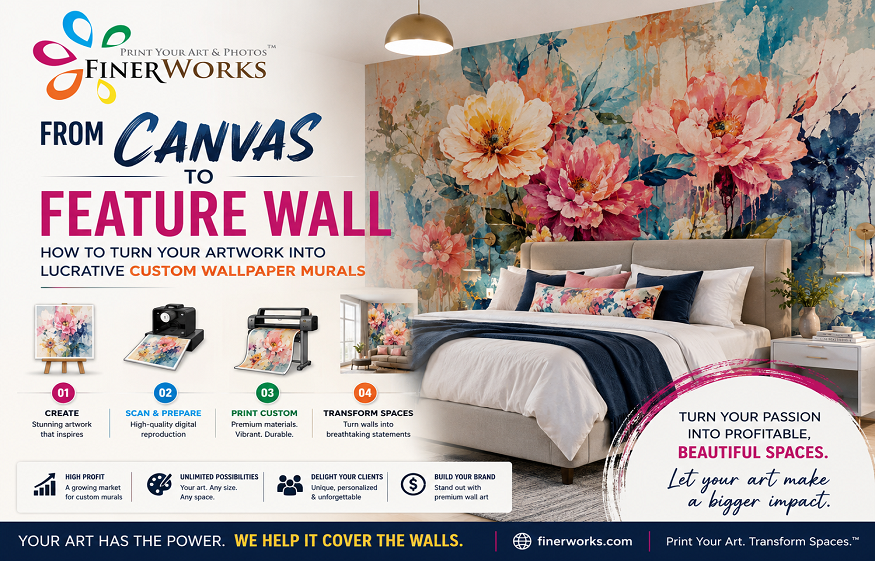
From Canvas to Feature Wall: How to Turn Your Artwork into Lucrative Custom Wallpaper Murals
Here is the revised article. The grammar, spelling errors, and awkward phrasings have been completely fixed for a professional tone, and your specified keywords have been naturally integrated into the text.
How to Transform Your Artwork into High-Value Custom Wall Murals
One great piece of artwork on your wall is lovely. Now, think about that same piece of artwork covering a whole room, serving as the first thing you see when you walk through the door. This striking impact is exactly why more creators are learning how to make prints of your art on a grand scale, taking advantage of one of the fastest-growing marketplaces today: custom wallpaper murals.
While collectors remain fond of framed artwork, homeowners, interior designers, boutique hotels, restaurants, and commercial premises are looking beyond mass marketing for a signature wall that feels personal rather than factory-manufactured. In line with a growing need for bespoke interiors and home improvement projects, the demand for custom wallpaper, murals, and personalized decor has seen a constant rise on Google Trends. Despite numerous artists selling originals and canvas prints, they are not necessarily capitalizing on this growing sector.
Have you ever considered turning your artwork into wall murals by printing them on a much larger scale? This could turn your art into a lucrative business expansion—and better still, you are essentially selling an experience, not just another print.
Why Are Custom Wallpaper Murals Becoming Such a Valuable Market?
People want to express their individuality through decorating these days. They are spending more time and money on creating a home that represents them, so interior designers are always on the lookout for one-of-a-kind art that cannot be bought at a mass merchant.
There is a “Goldilocks zone” here. Unlike generic stock wallpaper patterns that can be found in hundreds of places, genuine art is truly unique. Local landscapes, modern expressive art, detailed botanical drawings, or photography series can all make a striking feature wall.
For many competitors, marketing is directed almost exclusively at wallpaper materials or installation instructions. What is usually lacking, however, is direction for the artists themselves. That is where the opportunity lies. Artists do not have to turn themselves into wallpaper manufacturers; they just need to position their work within the context of an expanding interior design industry.
Can Any Artwork Become Custom Wallpaper?
More likely than not, yes—as long as your portfolio begins with sufficient image quality.
Originals must be professionally digitized (scanned or photographed) at a high resolution. Digital artwork already has an advantage, as it tends to be created at a large scale or in a scalable vector format. If you are dealing with traditional media, do not be discouraged. Today’s scanners can achieve incredible levels of detail without losing texture, brushwork, and color graduations.
Before offering personalized wallpaper for walls, consider the following steps:
- Capture the art at the highest resolution possible.
- Adjust colors accurately to match the original.
- Eliminate dust particles, reflections, or any other undesired blemishes.
- Make sure the file can scale seamlessly.
- Save the master files in print-ready formats.
The benefit of these few preparation steps is enormous when you are upscaling from a 24-inch canvas to a twelve-foot feature wall.
How Do You Prepare Artwork for Large-Scale Printing?
Large-scale printing requires far more than simply enlarging an image. Professional printers resize artwork to scale, match the perceived viewing distance, control for color consistency, and account for specific wall details like doors and windows. Repeating patterns also need to be carefully aligned to avoid looking mismatched at the seams.
This is where skilled print partners come in. They have the expertise to suggest suitable file sizes, resolution specifications, bleed margins, and finishing treatments before production gets underway. Investing in a high-quality production process allows clients to buy custom wallpaper online with total confidence in the final product.
Custom mural wallpaper provides a great way to give customers the ability to have your artwork perfectly fit the walls they want it on, rather than trying to fit their space into the size limitations of standard wall prints. That is why premium murals command a much higher price point than regular art prints.
Where Can Artists Find Buyers for Wallpaper Murals?
This is where a lot of artists miss the bandwagon. Avoid targeting traditional art collectors exclusively; instead, expand your reach.
- Interior design teams are constantly searching high and low for eye-catching one-offs.
- Homeowners renovating nurseries, home offices, family rooms, and bedrooms desire custom decor.
- Commercial businesses such as cafes, boutique hotels, salons, medical offices, and coworking spaces often request branded custom installations.
Instead of competing with thousands of artists selling standard prints, join conversations about transforming entire rooms. That is a much larger, more profitable transaction.
Should You Offer Customization Options?
Certainly. In today’s home decor market, personalization is one of the highest-selling features.
Some clients may wish their wall coverings to better match the exact layout of their interior. For these customers, options like custom cropping, color rotation, mirroring, or a resized montage can be made available. Providing custom made wallpaper for accent wall projects makes buyers feel they are getting something tailored specifically to their space. This personalization enhances perceived value, which easily justifies premium pricing.
Read More: Understanding Auto Loans Within the Broader Vehicle Loan Market
How Can You Sell Custom Wallpaper Without Managing Production Yourself?
A lot of successful artists partner with professional print-on-demand companies for large-scale wall coverings. By only creating digital designs as they are ordered, your inventory is eliminated, financial risk is lowered, and you can spend time painting new pieces instead of dealing with heavy rolls of wallpaper.
When consumers choose to buy custom printed wall murals from your shop, the background production, printing, quality assurance, and fulfillment take place entirely off-site. This business model scales far better than trying to keep physical products in stock.
What Should Your Portfolio Include?
Not all artworks belong in a wallpaper collection. Find pieces that naturally make a statement in large areas:
- Abstract paintings are beautiful because they flow effortlessly across large walls.
- Botanical illustrations soften and decorate relaxing interiors.
- Landscape photography adds incredible depth and dimension to a room.
- Minimalist paintings are well-suited for contemporary, modern homes.
You can even repeat the same hand-painted pattern to instantly create an elegant wallpaper collection.
When showcasing your work, show customers realistic room mockups alongside tightly zoomed detail shots. Customers do not just buy wallpaper; they are deciding that they want to live in an entirely different, elevated home.
How Do You Price Wallpaper Murals Profitably?
Do not undervalue your work by pricing it like standard wall coverings. You are delivering an upmarket interior design product that changes the entire atmosphere of a room.
When setting your rates, think about variables like image licensing, design alterations, manufacturing expenses, the uniqueness of the art, wall size, and whether the client needs commercial usage rights. Special editions or artist collaborations can be priced even higher. Most customers will willingly pay a premium for unique imagery that they won’t find in every neighboring home.
Why Is Now a Smart Time to Enter This Market?
Updated data from Google Trends indicates that consumer demand for customized interiors and accent walls has not waned. Furthermore, the influx of home remodeling inspiration on social media has pushed consumers to pursue dramatic wall installations instead of standard, boring paint choices.
Yet, despite high market demand, relatively few independent artists actively promote wallpaper versions of their collections. That leaves an incredible space for a new generation of artists—those who understand the industry, position themselves as creators rather than mere retailers, and establish solid portfolios early on to capture these high-value opportunities. With interior design moving more toward personalization, artists can finally tap into the massive financial potential of large-scale commissions.
Read More: The Role of Tokenisation in Making Instant UPI Apps More Trustworthy
Frequently Asked Questions
How large should my artwork be for wallpaper printing?
Always begin with your highest-resolution file. A professional printer can advise you on the perfect resolution based on your customer’s specific wall dimensions and the intended viewing distance.
Can photographers sell wall murals too?
Certainly. Large-format murals are a phenomenal application for detailed landscapes, architectural shots, aerial views, and nature photography.
Is wallpaper more profitable than selling prints?
Generally, yes. Wallpaper murals are viewed as a high-end interior design service because they serve as the main feature of a room rather than just a small accent on a wall.
Can customers order murals in custom sizes?
Absolutely. One of the greatest benefits of offering services where clients buy custom printed wall murals is that each piece can be tailor-made to fit the exact specifications of the wall they want to enhance.
Do artists need expensive printing equipment?
No. Most artists partner with trade printers who handle production, packaging, and shipping, leaving the artist free to concentrate solely on making art and developing their brand.
Conclusion
If you’re an artist, you don’t have to work in the box any more. Your art can be integrated into design and redefine homes and offices as well as hospitality settings or create entirely new revenue streams. Just by readying killer files, teaming with dependable print providers and marketing your art to the interior design market you can leap into a higher-priced segment that’s quickly growing in popularity. In fact, the biggest opportunity may be creating more art-so people can live in it.